
HyperQuantLab

Hyperliquid data engineering

Hyperliquid, recorded at the source.

HyperQuantLab runs its own Hyperliquid node, keeps every byte it records, and engineers it into data products for traders, risk teams and builders.

Archive: 20.6 TB preserved and verified Capture: relaunching on dedicated servers Products: in development

Already built

The hard part is done, and measured.

Between June and July 2026 the engine ran at full scale. These numbers come from our own archive and database logs.

20.6TB

of raw Hyperliquid node data captured in its original form.

23,541

archive segments, each read back and checked against its fingerprint.

1B+

rows loaded and queried in our analytics database.

772

markets identified: perpetuals, spot pairs and HIP-3.

The engine

One node. Seven streams. Every byte verified.

Most Hyperliquid tools start from the public API. We start one step earlier, at the node itself, and keep the full record.

The public API gives you

  • Trades and the order book
  • Candles and prices
  • What every other dashboard shows

Our node records the full story

  • Every order placed, cancelled and filled
  • TWAP executions as they run
  • HIP-3 oracle updates, per market
  • Liquidations, protocol actions and HyperEVM blocks

Products

One engine, three ways in.

For traders

Trader Lab

Study the market, practise, and get better before you risk capital.

  • Replay past episodes without seeing the future, then compare your call with what happened.
  • Visual views of order flow, liquidity and liquidations.
  • An AI tutor that explains what you see and shows its evidence.

Status: in development
For risk teams

Risk & Integrity

Early warning on what hurts trading firms: bad prices, cascades, unusual behaviour.

  • HIP-3 oracle health: is each price fresh, and does it match its reference?
  • Liquidation watch across the venue.
  • Wallet behaviour patterns, kept pseudonymous.

Status: in development

For builders

Data API

The same verified data for your software, your analysts and your AI agents.

  • A typed API for markets, oracle state, liquidations and episodes.
  • MCP tools so Claude, ChatGPT and other agents can query it safely.
  • Every answer says where it came from, and when it can't answer.

Status: in development

Instruments

Real node data, already on screen.

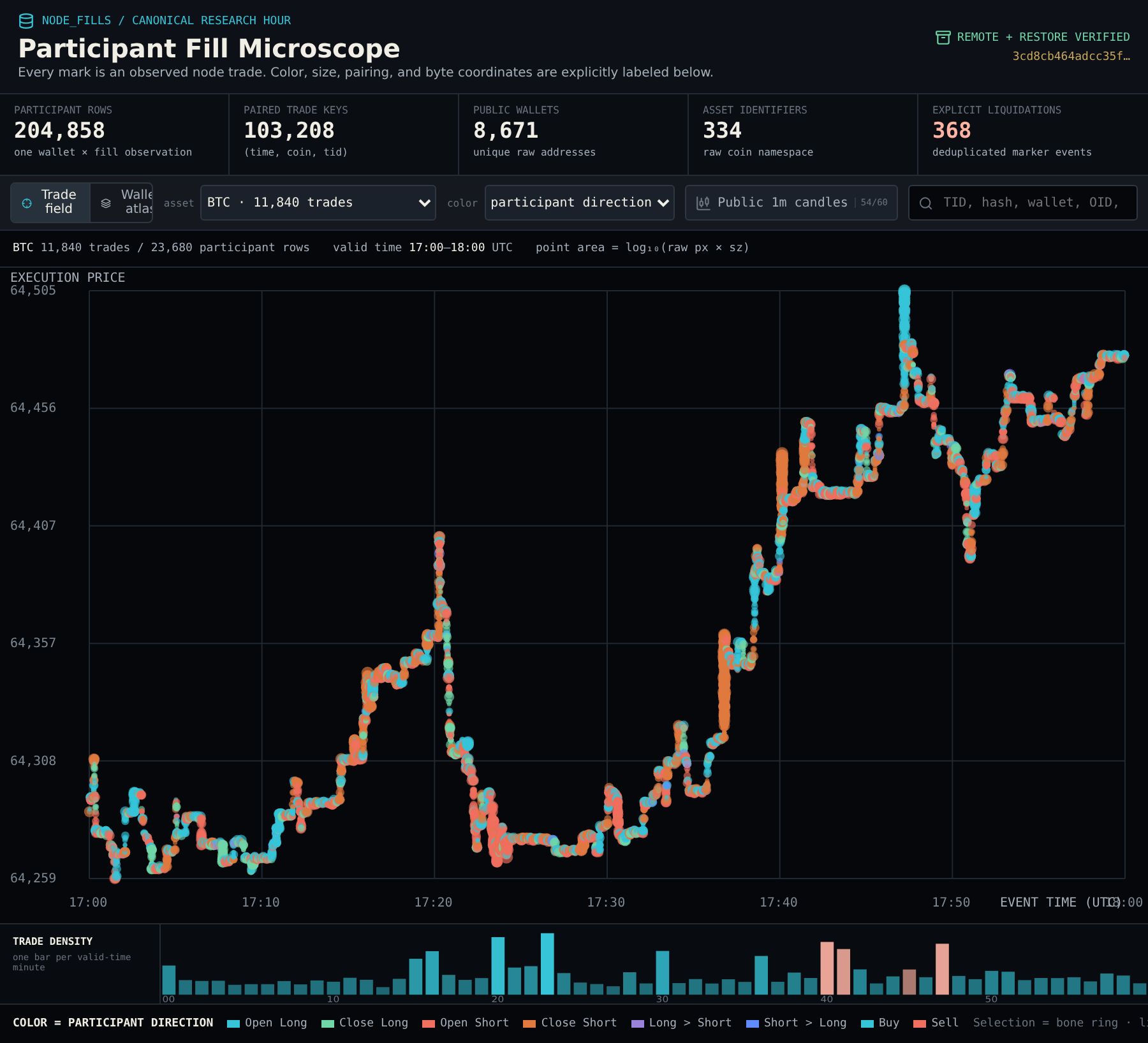
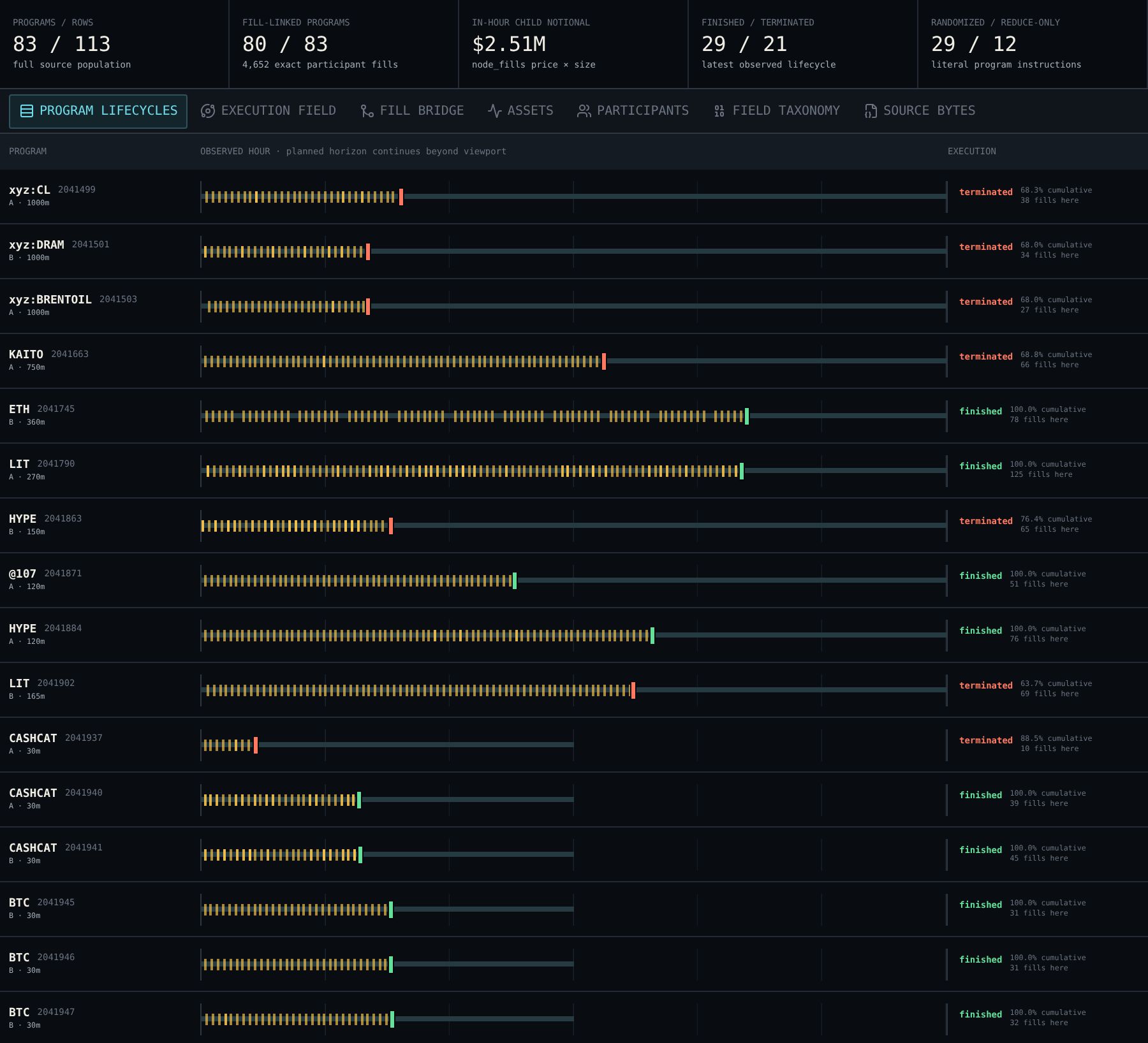
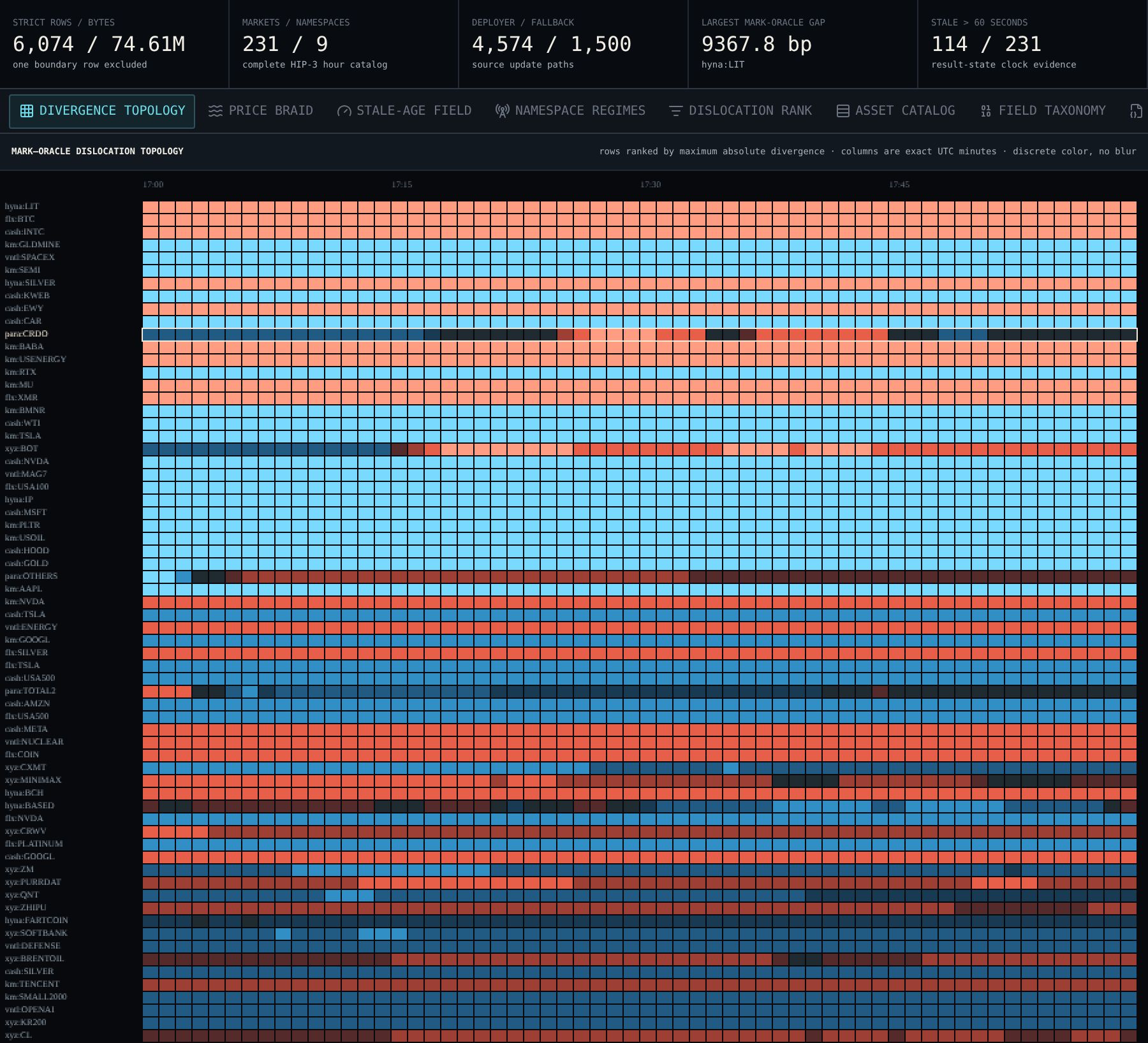
The Market Topology Atlas is our working research instrument. Every view reads real data from our own node. Click any of them to open it live.

Sample data: 18 July 2026, 17:00–18:00 UTC. Ten instruments in total. Open the Atlas ↗

Research

We test ideas, and keep the ones that fail.

Edge is not a claim. It is a hypothesis that survived the data, the clock, the replay, the costs, and the attempt to disprove it.
Rejected-order signal117 million records parsed. It added nothing over simpler baselines.Rejected
Trade-flow modelA tiny improvement that became a loss after a 1 basis-point trading cost.Not promoted
Order lifecycle flowHow orders are placed, cancelled and filled beat the public-data baseline on held-out data.Qualified lead
Wallet ecology264 million order observations. Clear groups of liquidity providers and takers, with distinct reaction speeds.Confirmed pattern

Where we are

Built, relaunching, then shipping.

  1. Built · Jun–Jul 2026

    The engine

    • Node capture of all seven streams
    • 20.6 TB verified archive
    • Over 1 billion rows in ClickHouse
    • Ten research instruments
  2. Now

    Relaunch

    • Two dedicated servers: one to capture, one to serve
    • Continuous capture, around the clock
    • Instruments switched to fresh data

Who builds it

HyperQuantLab is built by Rick, a data engineer, working with a team of AI agents. The first version, from node to verified archive to a billion queryable rows, took one month and one server paid for out of pocket.

The principle hasn't changed: keep the market's memory intact, ask harder questions, and trust only what can show its evidence.

Follow the build.

Field notes, market episodes and new instruments go to X first.

Follow HyperQuantLab on X ↗